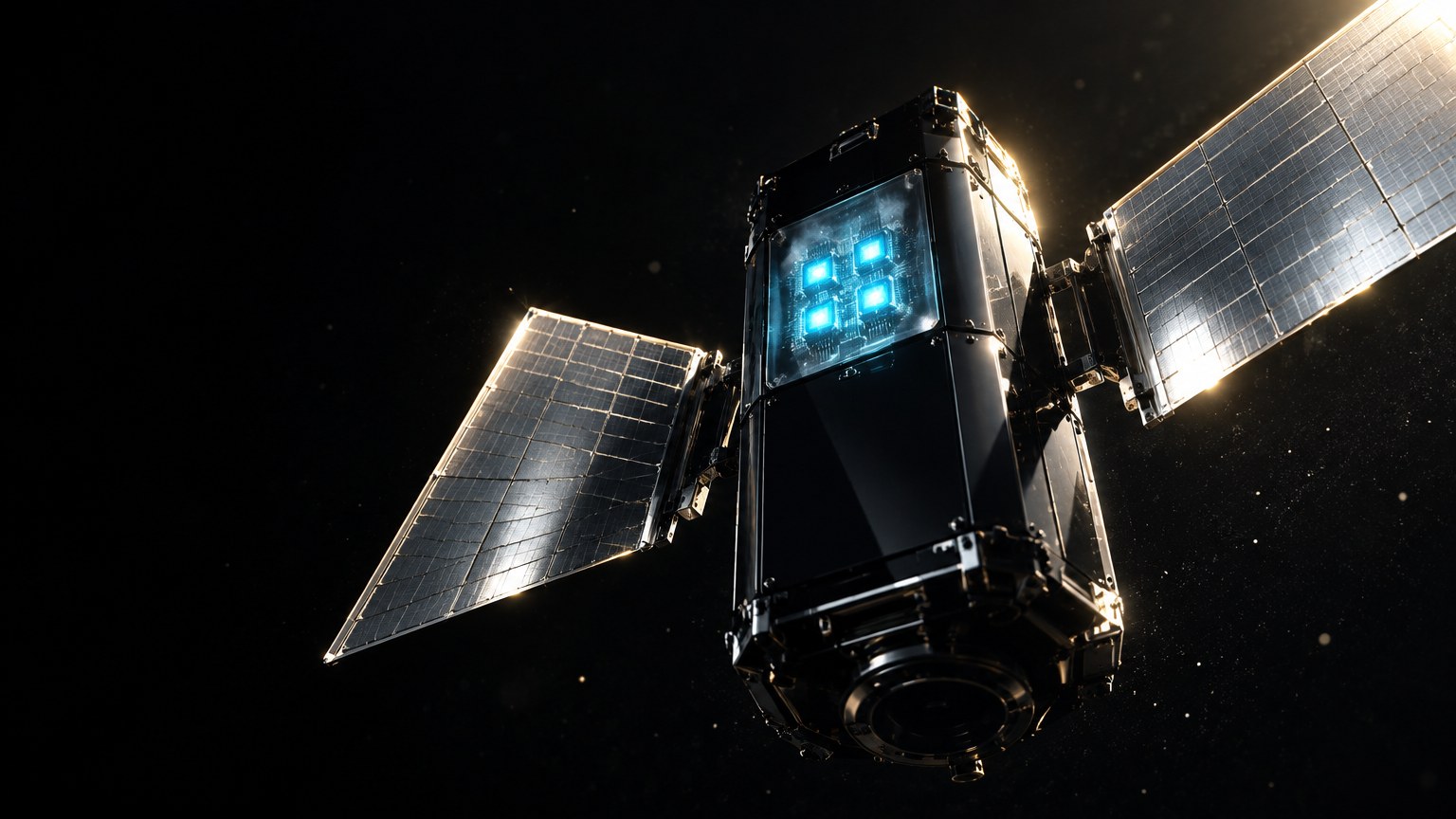
On 1 October 2026, Google launched a prototype satellite carrying four Trillium-generation TPUs into low Earth orbit. Google confirmed contact after launch and says the satellite is operating as expected. Ground tests suggest the chips can cope with radiation. The tighter constraint is heat: Google says the satellite has to power down regularly so it does not overheat.
What actually launched
The satellite is internally called MVP, for minimum viable prototype. It is roughly the size of a refrigerator and was built in partnership with Planet. It flew on a SpaceX Falcon 9 from Vandenberg Space Force Base on the Transporter-18 rideshare mission. According to the New York Times, as cited by CNN, its solar panels supply about 1 kW to the TPUs; Google declined to confirm the power figure. A Google spokesperson told CNN that the vehicle will “have to power down every 20 minutes, because we don’t want it to overheat.”
Keep the scale in proportion. Four TPUs on about 1 kW is roughly one server’s worth of compute. Futurum’s pre-launch analysis compares it to a Google Cloud TPU v6e-4 slice. The next step is a pair of prototype satellites in 2027 to test optical links between satellites, and the Google spokesperson told CNN those satellites will run continuously without shutting down to avoid overheating. There is no committed date for a full constellation. Google’s Suncatcher design paper describes an 81-satellite cluster as an illustrative configuration, not a plan with a timeline.
Why cooling, not radiation, is the story
Radiation was largely settled on the ground. Before launch, Trillium chips were tested in a proton beam at UC Davis’s Crocker Nuclear Laboratory. According to Google’s Suncatcher design paper, they kept working up to the maximum tested dose of 15 krad(Si), about 20 times the 750 rad(Si) a shielded five-year mission is expected to see, with no hard failures. High-bandwidth memory was the weak point, showing irregularities above 2 krad(Si). The most common soft error was silent data corruption in core logic and on-chip memory, at roughly one event per 17 rad; Google estimates that at about one error per 3 million inferences in orbit, acceptable for inference but a harder question for training. These are commercial chips, not radiation-hardened parts, so each new TPU generation could in principle follow the same qualification path.
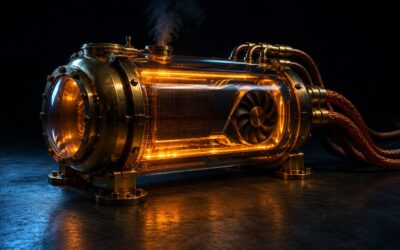
Heat is a different matter. In a vacuum there is no air for convection and no water to evaporate. A satellite can only get rid of heat by radiating it from external panels, so radiator area and mass grow with chip power. Caleb Henry of Quilty Space told CNN that operational telecoms satellites run on roughly 10 to 20 kW. According to CNN, a new Google paper in the journal Joule says data centre satellites may need 50 to 100 kW, about what a terrestrial rack draws. MVP’s forced power-downs at around 1 kW show how far the thermal design still has to go.
The economics are just as unproven. Google’s Suncatcher design paper estimates that launch prices could fall below $200 per kilogram by around 2035, the level at which launched power starts to look comparable with terrestrial energy costs. Its reference price for today is about $3,600/kg. Getting there would take roughly 180 Starship launches a year, a cadence no rocket has demonstrated. Google’s James Manyika put it plainly, as quoted by Futurum: “We don’t expect, to be perfectly frank, that we’ll have anything usefully operational in the next few years.”
What it means for Irish, UK and EU businesses
Nothing changes in your infrastructure plans this decade. Your inference will run in terrestrial cloud regions on terrestrial grids, and orbital compute won’t ease capacity or pricing pressure on those regions any time soon. What is new is that one of the largest buyers of AI compute is now spending real money to test a supply route that avoids land, water and grid connections altogether. That tells you how hard Google expects those inputs to stay.
There is also a practical engineering lesson. Suncatcher’s pre-launch debate centred on radiation, and that turned out to be the easier problem. The limit that actually sets the system’s ceiling only became clear once real hardware was built and tested. The same pattern shows up in automation work: the bottleneck you plan around is often not the one that binds, and you usually only find out by running a small instrumented version.
What to do now
Don’t buy orbital compute and don’t redesign anything around it. Do check how tightly your AI stack is tied to one region, one provider or one capacity assumption. If your workloads can move between regions and providers, you can take advantage of new capacity wherever it appears, on the ground or eventually in orbit. That kind of portability is how you build systems that compound rather than ones that have to be rewritten. Then copy Google’s method. Ship the minimum viable version, instrument it, and let the telemetry tell you where the real constraint is before you scale.
Sources: CNN, 1 October 2026; Google’s Project Suncatcher post; Google Research blog and design paper; Futurum.
Frequently Asked Questions
Is Google running a data centre in space now?
No. The MVP satellite carries four TPUs on about 1 kW, roughly one server’s worth of compute. It is a hardware survival test, not a working data centre.
Why can the satellite only compute in short bursts?
In a vacuum, heat can only leave through radiator panels. The current thermal design cannot reject heat fast enough for continuous operation, so Google told CNN the satellite has to power down every 20 minutes to avoid overheating.
When could orbital compute compete with ground data centres?
Google’s Suncatcher design paper estimates launch prices could fall below $200/kg by around 2035. That depends on a Starship launch cadence that has not been demonstrated yet.
Want this working in your business?
D3X Solutions LABS builds AI agents and automation that pay back fast. Set up a free 30-minute call and we will map your first win together.
Get in touch